This week I am featuring a guest blog post by writer Halee Kirkwood to foster reflection on the act of writing while on Dakota land. A descendant of both Swedish immigrants and Fond du Lac Ojibwe, Halee walks readers through their practice of writing on place.
Issues of migration and belonging are one of my primary obsessions, as a mixed white and Ojibwe writer. I am someone who is capital-F From the Northwestern Lake Superior region. This is where my tribe, the Fond du Lac Band of Lake Superior Ojibwe, settled after the great Ojibwe migration nearly 1,500 years ago. This is also where my white family, composed mostly of Swedish immigrants, settled. I like to joke that, ancestrally, I’m fish and berries all the way down. I’m wetland and sturgeon, Manoomin and Krumkake cookies. It is with great pride (and autonomy) that I write about this landscape and my family’s history here; however, I sense an unnamed pressure to only write about this area, as if an Indigenous writer cannot write about places that aren’t ancestrally their own. It begins to make you feel as though you’re writing in a literary zoo, the zhaaganaash gaze satisfied that you’re placed neatly in their government-defined bounds.
Lately, I’ve been thinking about travel writing as a continuation of the Ojibwe migratory tradition. We’ve always been wanderers. We lived along the Northeastern Atlantic coast before warfare with neighboring Haudenosaunee (no shade) and prophecy propelled our journey as Anishinaabe people westward, tracing the Great Lakes and splitting off into other tribes, including the Potawatomi and Odawa. We stopped at what are now known as Niagara Falls, Detroit, Manitoulin Island, and Sault Ste. Marie, though none of these are places I’ve yet been. I’ve been called more westward, as were my ancestors who continued on toward the far western tip of Lake Superior after a large contingent of Ojibwe made their home on Madeline Island, considered the spiritual center of our culture. Even more westward still were bands of Ojibwe who traveled as far as North Dakota, where the Turtle Mountain band now resides, and even Montana, where the Little Shell tribe was just federally recognized in 2019.
I live now in what is recently called Minneapolis, known as Bdé Óta Othúŋwe to the Dakota people whose creation, present, and future are bound with this landscape. While Ojibwe and Dakota people have a long and storied history with each other, with political boundaries for each nation having historically been in flux, Bdé Óta Othúŋwe is decidedly Dakota land, and I write here not as a child belonging to these waters, but as a traveler and guest. It would be disingenuous to write poems situating myself here, in my Northeast Minneapolis duplex a half-hour walk away from the St. Anthony Falls that used to roar undammed, as a voice for the land. I cannot speak for a place that does not claim me.
The question to me, then, is if we ethically must not speak for places that aren’t our own homelands, how can we speak of them? I find myself drawn lately to travel and to write toward the lands of other sovereign nations, with as much respect and humility as I can. In the settler-defined boundaries of Minnesota, I’ve grappled with this at Blue Mounds State Park in southwestern Minnesota. Here, my partner and I found ourselves lost and dehydrated on a prairie walk, where abundant families of turkey vultures circling low made us aware—predictably—of our mortality, but also of wonder and delight, how the early June air must have felt rustling beneath their rich brown undercarriages.
But when researching the Indigenous history of the park—which is a short drive to Pipestone National Monument, another significant and sacred Indigenous site—I could find no comprehensive history in the park or on its website of who specifically lived around the bluff, only that the Indians used it as a buffalo jump. Driving north back to Bdé Óta Othúŋwe, just outside of the Mdewakanton Lower Sioux community, we passed a small sign announcing the site of Birch Coulee, one of the most deadly battles of the US-Dakota War. One cannot write about the beauty of this landscape without also acknowledging the infinite layers of tribal belonging, displacement, violence, and futures that we move through every day, in a way that goes beyond the cookie-cutter land acknowledgment. This is something I believe nature and travel writers in particular need to deeply internalize. Something I’m still grappling with when trying to write a poem about this area—the poem is not done until I’ve done all I can to represent this complexity of my body, my white and Ojibwe body, on the page.
This is an ethical compass I hope to more fully articulate for other writers, Native and non-Native alike, whose themes include travel and landscape. To be more aware of one’s positionality on the land will inherently deepen the writing, imbue it with complexity, clarity, and curiosity. Further, I think it’s important to consider how we carry our homes—whatever those homes look like—with us on our travels. For me, I think of myself as an ambassador for wetlands in contrasting landscapes, such as the Colorado Desert, on the land of the Agua Caliente Band of Cahuilla, where the glow of the San Andreas fault reminded me of the Earth’s own idea of boundary. My understanding of how the fur and lumber trade histories came to be an essential component in defining Ojibwe and white settler relationships makes me curious about the complexities of trade and industry in other areas, such as the devastating effects of the Gold Rush on California and Pacific Northwestern tribes. On Suquamish land, taking the ferry to Bainbridge Island, foggy islands looming in the distance give me a feeling that may have been familiar to my ancestors when they arrived at Mooniingwanekaaning-minis, otherwise known as Madeline Island. I think also of the Japanese American forced removal from Bainbridge and the displacement of Ojibwe people from our spiritual center to make room for the settler village of La Pointe. I circle around these topics, the immense body of Lake Superior like a magnet drawing me back to what I most intuitively know. It is with the memory of these other places throughout Turtle Island that I will soon retrace the footsteps of my ancestors back to the Atlantic coast. I want to see a glimpse of what they saw as they took the long voyage west, to offer an alternative story in the canonical literature of the west. To understand where my desire to cross the next horizon, my draw toward unknown figures in the distance might come from. My curiosity about new places, the people, histories, plants, animals, and waterways there. This is a curiosity—and a profound source of love—that I hope to encourage in others, as we all reckon with where we are, and where we come from.
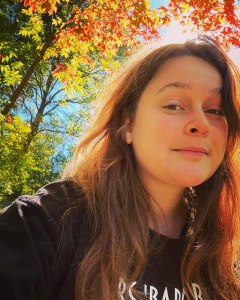
Halee Kirkwood is a poet, teaching artist, and bookseller living in Minneapolis, Minnesota. The winner of the 2022 James Welch Prize and published with Poetry Northwest, Mx. Kirkwood is also a 2023-25 Jerome Hill Artist Fellow, and has received fellowships from In-Na-Po (Indigenous Nations Poetry), The Loft Literary Center’s Mentor Series program, and a grant from the Minnesota State Arts Board (2022). Their work can be found or is forthcoming in Poetry, December, Ecotone, The Florida Review, Gulf Coast Journal, Water~Stone Review, Poem-A-Day, and others. Mx. Kirkwood earned their MFA in poetry from Hamline University. They are a direct descendant of the Fond du Lac Band of Lake Superior Ojibwe.


Patti Kameya is a fiscal year 2022 recipient of a Creative Support for Individuals grant from the Minnesota State Arts Board. This activity is made possible by the voters of Minnesota through a grant from the Minnesota State Arts Board, thanks to a legislative appropriation from the arts and cultural heritage fund.

 Patti Kameya