October 5, 1927.
Arose at 6. Partly cloudy. Drove to Faribault to see Kiyoshi. Gave him things. Saw boy’s drill and found Kiyoshi has trouble to carry gun which is too heavy for him. Stayed there short while and left the school and reached home at 12:10 noon. Business was very poor to-day.
In brief diary entries Mr. Kitagawa logged the movements of his business and family. This rare description hints at his concern for his son Kiyoshi, a thirteen-year-old eighth grader at Shattuck School, an Episcopal military academy two hours south of his Minneapolis home. In the late 1920s and early 1930s the school attracted boys from the Midwest and mountain states, and occasionally as far away as Santa Monica, California. One or two students hailed from places like India and Uruguay, but their names and faces appear to be white. Shattuck was not Hogwarts, a place where misfits learned to use their innate magical powers. Ten years after the armistice that was supposed to end all wars, Shattuck School fostered muscular Christianity: football, military drills, and Wednesday vespers. Amid the cadets’ black and white photos, Kiyoshi stands out as the only nonwhite student. The social norms, too, assumed whiteness. The February 20, 1929 Spectator gossip column ran, “[Cadet] Mason, while reviewing his tactics, brings up the inevitable gag, ‘Where do they get the negro for the Color Guard?’”
What was Kiyoshi’s life like there?
I searched the Spectator and other student publications for Kiyoshi’s story. Before this, I had only his father’s diaries. Mr. Kitagawa seemed disappointed in his son, but Kiyoshi eventually found his own way. He graduated from Shattuck and started the University of Minnesota business program as Prohibition was ending. After graduating from the U, Kiyoshi continued to stay out late like a student, so his father sent him to San Francisco in 1937 to work with another Japanese American merchant. Kiyoshi became a well-regarded assistant and married a Japanese American woman. In 1942 Kiyoshi and his in-laws were sent to an incarceration camp in Poston, Arizona, which he left to serve in the legendary 442nd Regimental Combat Team of the US Army. He survived the brutal mission where his unit rescued the Texas “Lost Battalion” in Italy. To save 200 soldiers, his unit sustained several hundred casualties. He received a Purple Heart and a Bronze Star for his service.
When I first tried to write Kiyoshi’s story, it hinged on a clichéd negotiation of Japanese and American culture. It felt fake. It dodged the complexity of Japanese, American, and Japanese American experiences. Christian military academies like Shattuck were unusual for both European and Japanese Americans—cities like Minneapolis were still building new public schools to educate a growing workforce. Both schools and civic groups like the Daughters of the American Revolution (DAR) taught ideas of Americanness to families from Germany, Poland, and Scandinavia so that they may become good US citizens, but Kiyoshi’s parents and other Asians could not naturalize until 1953. Kiyoshi’s family could not join the “melting pot” because his parents and those of his white classmates had unequal privileges. How did Mr. Kitagawa feel when he read newspaper stories of new Americans sworn in as citizens in local courtrooms?
In his first year at the U, a local DAR chapter recognized Kiyoshi for his skill in drill as a first-year ROTC cadet. On the first page of the May 25, 1933 Minneapolis Tribune appears a photo of Mrs. George R. Jones presenting Kiyoshi his award as two older military officers look on. Her brow is slightly creased, and the lines around her mouth are difficult to read. Perhaps she is simply saying “congratulations.” Kiyoshi seems to be smiling, so the woman’s expression may have resulted simply from the sun shining too brightly on her face, which is not well protected by her hat. Perhaps she is surprised because she knows that even if Kiyoshi’s parents attended DAR citizenship training, they could not become citizens.
Kiyoshi’s Midwestern middle-class merchant background differed from that of many Japanese Americans at the time. Most Japanese Americans lived either in Hawaiʻi or on the West Coast near other Japanese Americans. Perhaps Kiyoshi did not feel like he was among his people in the camps populated by West Coast Japanese Americans—the Buddhists, the Christians, the shopkeepers, the agricultural workers, the teachers, the laundry owners. Many Japanese American men at Poston felt conflicted about enlisting for military service while their families remained incarcerated without evidence of either criminal action or intent. While Kiyoshi might have understood the reasoning, the idea of resisting the draft probably grated against his military academy adolescence.
Kiyoshi also stood apart from Japanese Americans from Hawaiʻi who made up two-thirds of Kiyoshi’s unit during World War II. Kiyoshi attended white public and private schools; Hawaiian Japanese Americans came from a segregated school system where white students attended better-equipped “standard English” schools. Accounts in works such as Daniel James Brown’s Facing the Mountain depict Hawaiian Japanese Americans playing the ukulele. Although the MacPhail School of Music that Kiyoshi’s sister Nobu attended had offered ukulele instruction since 1916, classical piano filled Kiyoshi’s home.
To understand Kiyoshi’s story, we must return to his formative years in Minnesota. How did Kiyoshi fare at his Minnesota boarding school? And how did his military school training help him survive one of the most brutal battles of World War II? I visited the town of Faribault and the Shattuck School for answers.
On modern freeways, the drive to Faribault takes under an hour in fair weather. As I watched for semitrucks pulling onto the interstate, I tried to imagine what Mr. Kitagawa saw on his first two-hour drive in 1927. Smaller farms? Livestock crossing the road? Did women and children walking to church stare with curiosity or mistrust? Mr. Kitagawa expressed concern when one farmer cut his hand while helping him restart his car between Farmington and Northfield. Any other stories from the route to Faribault seemed buried under the six-lane asphalt stretch, under clusters of gas stations announcing prices on green and white displays visible from miles away. The off-ramp marked “downtown Faribault” empties into a four-lane local highway pushing quickly into the town. I turned left onto Hiawatha Pioneer Trail, which connects to neither Hiawatha Avenue in Minneapolis nor anywhere the historical Onondaga leader Hiawatha (c. 1450) might have tread.
As I entered Faribault for the first time, I saw a Somali mother guide her children out of her minivan. Growth and change continue in Rice County, which presidential candidate Donald Trump carried by a 3.06% margin in 2016 and a 0.17% margin in 2020. Between the 1990s and early 2000s, Faribault’s nonwhite population increased by over 200%. When I saw this thriving Somali family I realized that Rice County was already home to a diverse population. I might not be the first middle-aged Asian woman doing research there.
Rice County Historical Society was busily preparing for the county fair, but the executive director Sue Garwood kindly helped me. She answered my questions and dug out a home movie of Shattuck cadets walking into town. What kind of Faribault did Kiyoshi find in 1927? Sue acknowledged that Kiyoshi might have been bullied at Shattuck. On the other hand, Rice County showed signs of friendliness toward Japan. In 1923 Northfield, a neighboring town known for both Carleton and St. Olaf colleges, raised money for victims of the Great Kanto Earthquake that destroyed much of Tokyo. The year Kiyoshi entered Shattuck, the Faribault Daily News noted the fourth anniversary of the earthquake. A separate story marked the start of Shattuck’s school year and mentioned that this year’s new students included “one Japanese boy” with no further comment. Kiyoshi was not the first Japanese Faribault resident—Rev. George Whipple, the brother of Shattuck founder Bishop Henry Whipple, had a Japanese house servant who died in 1883. Some incidents hint at a relatively good climate for Black and Indigenous people. The town’s namesake Alexander Faribault had Dakota ancestry. We also cannot ignore that the Ku Klux Klan held a statewide convention in Faribault in the 1920s. Sue pulled out several Shad yearbooks and student handbooks for me to peruse for the day.
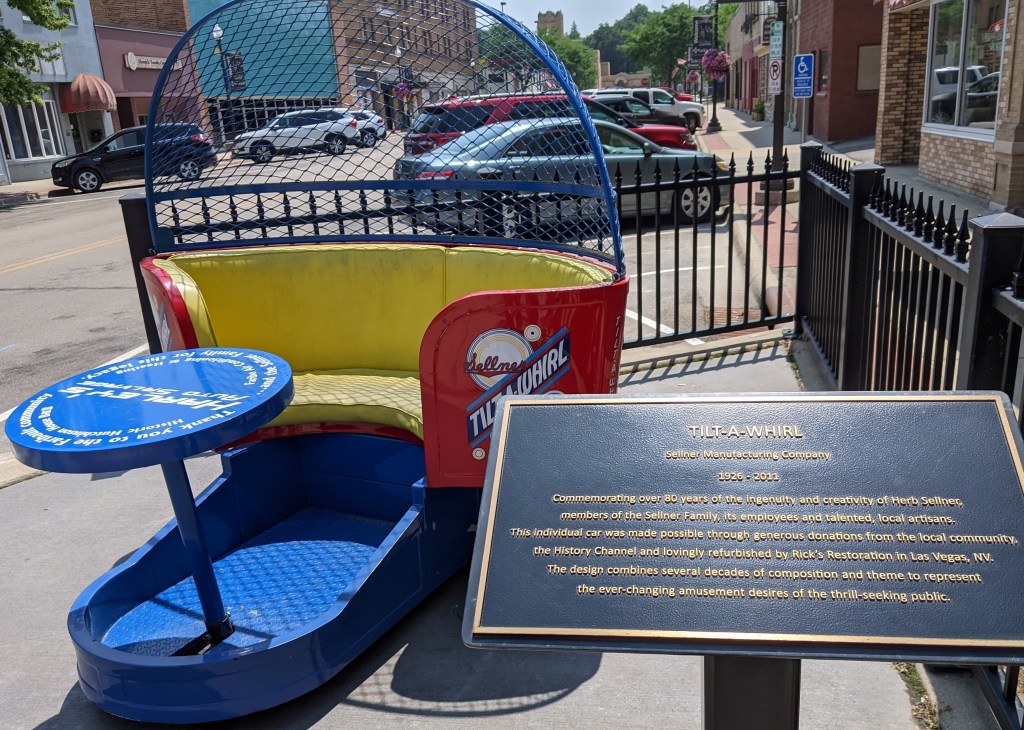
At lunchtime I drove into downtown Faribault, one of the longest historic districts in the state. Many buildings seemed unchanged since Kiyoshi strolled through with his fellow Shads. Sidewalk benches preserved one memory of Faribault: stories of white leaders and early businessmen who powered the economy. There were also vintage cars from Tilt-A-Whirl, a locally invented amusement park ride launched the year before Kiyoshi arrived. The Faribault Daily News advertised that one could ride the Tilt-A-Whirl at Roberds Lake, seven miles from Shattuck. Those ads did not appear in Shattuck’s Spectator. Kiyoshi might not have tried it at Roberds Lake, but he may have rode it at the state fair, where his father ran two booths.
Many downtown Faribault businesses offered experiences updated from the Faribault of old: coffee alfresco with sandwiches made to order, gift shops with locally crafted candles and tea cloths. Another Faribault was also emerging: small immigrant-owned businesses that sent money to Somalia and beyond, and an immigrant-staffed pawnshop that sold jewelry, gold, and guns. One storefront housed the Faribault Diversity Coalition, whose mission statement reads, “bridging cultures to foster understanding and community well-being.” The historical narrative of the benches, the Tilt-A-Whirl carriages, the white-owned businesses, and the immigrant-owned businesses seemed to dance together warily. I had lunch at a Mexican restaurant with outdoor seating. It was July 2021, a few months after the vaccine rollout and reports that vaccinated people may still get Covid. I dined alone on the patio while others ate inside.
After lunch, I looked through more student handbooks. What rules governed the cadets’ behavior? How did the school entice parents to send their sons there? What did they teach? Kiyoshi’s page in the Shad yearbook sparked more questions. His classmates dubbed him “Kitty,” a mild nickname—some cadets’ nicknames included derogatory references to weight. Other nicknames looked like racial or ethnic slurs, even though the cadets’ faces and names were white. Kiyoshi made the rank of first lieutenant, second to the captain of his unit. The Shad staff wrote, “There are few who know more about drill than Kitty, and in the class-room he is equally brilliant,” but the student newspapers indicated ups and downs in his grades. How did a short Japanese cadet become first lieutenant in a time of anti-Asian immigration laws and US–Japan imperial rivalry?
In subsequent visits to Faribault, I sought answers in the photos I took of student newspaper spreads. As it adapted to the times, Shattuck has not had the resources to preserve its historic student newspapers as either microfiche or digital files. Shattuck merged with its sister school St. Mary’s, adapted its curriculum, and welcomed more foreign students. If they were still alive, Kiyoshi and his father might feel some nostalgia driving through the old Whitney Arch, which was built the year before Kiyoshi entered Shattuck. And after going through the arch, they might be pleasantly surprised to see a new dormitory called Seung Youn Kim Hall.
Hollywood celebrated the heroism of Kiyoshi and the rest of his unit in the 1951 film Go for Broke. Kiyoshi’s father saw it at least twice. Unlike most other World War II veterans from the Greatest Generation, Kiyoshi spent the prime of his life in military contexts. He was introduced to military culture at age 13 at the Shattuck School, and stayed in the military until age 49. After finishing Shattuck, Kiyoshi entered the ROTC at the University of Minnesota. He lived for five years as a civilian on the West Coast, then was sent as an “enemy non-alien” to a camp surrounded by barbed wire and watchtowers looking in. Even if he were not guarded by former classmates from either Shattuck or University of Minnesota ROTC, the guards probably reminded him of his own soldier days, schooldays with leisure hours spent cleaning rooms, shining shoes, and studying military tactics. Unlike the Poston draft resisters, Kiyoshi probably saw military service with a segregated Japanese American unit as an opportunity to improve conditions for his family and his nation. After the war he worked in intelligence for the US occupation of Japan. His grave at Fort Logan National Cemetery indicates that he attained the rank of major. Popular culture cues us to call Kiyoshi and his comrades heroes and carry on without considering either the continued costs to veterans after returning home or how we may change to end all wars, the hope expressed after the Great War, which we now call World War I.
I picture Kiyoshi in front of me. Perhaps he is smoking menthol cigarettes. The easy smile of the freshman ROTC cadet has vanished. His hairline and weary stare belong to a man in his late 40s, but he is only 33. He might wonder why I, the great-grandchild of sugarcane plantation laborers, want to know about him. I want to know how he feels. How does he connect his experiences in Minnesota, including Shattuck, and the person that he became? Did he live his best life in Minnesota? What does he want people in modern-day Minnesota to understand about his story?
In my next blog post I will describe my search for Kiyoshi’s activities and friends while at Shattuck, and then consider how the US-Japan imperial rivalry may have affected his socialization in Minnesota.
My deepest gratitude to the Kitagawa grandchildren for offering their insights to help me understand their family.


Patti Kameya is a fiscal year 2023 recipient of a Creative Support for Individuals grant from the Minnesota State Arts Board. This activity is made possible by the voters of Minnesota through a grant from the Minnesota State Arts Board, thanks to a legislative appropriation from the arts and cultural heritage fund.

 Patti Kameya
1 comment